About the project
The task of the Accelerating Climate Efforts and Investments (ACE LIFE) project is to support Finland in halving emissions from the effort-sharing sector by 2030 and achieving carb

The project focuses on the challenging actions aimed at reducing emissions in agriculture, heavy vehicle transport, and industrial machines.
Solutions to be developed in the project include value chains for paludiculture, plant-based proteins, and biogas, promoting low-emission energy use and energy efficiency measures for heavy vehicle transport and machinery. The project supports the implementation of the goals of the Finland’s Climate Act Accords and the EU Effort Sharing Regulation emission reduction obligations by preparing proposals and information services to enhance policy measures and climate financing.
The 20 million euros in funding will be used for implementing significant pilot and demonstration investments in Finnish companies while promoting actions for scaling them. The project supports Finnish efforts to implement emission reduction measures and investments, enabling the improvement of Finland’s energy self-sufficiency and security of supply, reducing the costs incurred from climate change, while positively affecting Finland’s competitiveness and economy.
The ACE project will be implemented in 2024–2030.
The project in a nutshell
- Goal: To help Finland achieve the emission reduction requirement of the effort-sharing sector by 2030 and to reach the goal of carbon neutrality goal by 2035.
- Focal points: Especially the so-called challenging reductions in emissions in agriculture, transport and industrial machinery
- Duration: 2024–2030 (7 years)
- Budget: 20 million euros
- Main funder: The LIFE programme of the European Union
- Consortium: A national cross-sector project of more than 50 actors from areas including public administration, research institutions, enterprises, and foundations.
Focal areas of emission reduction action

Agriculture
Greenhouse gas emissions from Finnish agriculture originate in the effort sharing and land-use sectors primarily in the digestive systems of production animals, manure, and the soil. Most of the emissions from the soil are from the land-use sector, where the primary source of emissions is drained peatland. As a solution, ACE is developing value chains of plant-based proteins and paludiculture, while promoting the use of biomethane.
Heavy vehicle transport and machinery
Heavy vehicle transport and machinery continue to be powered mainly by fossil fuel. ACE promotes the electrification of heavy vehicle transport and machinery and the use of biomethane and clean synthetic methane by demonstrating and developing charging and refuelling infrastructure and by piloting transport and machinery in the forest, metal and food industries.

Industry processes
Emissions come from the use of oil and natural gas in boilers, ovens, and other machinery and equipment that require high temperatures or high output. As a solution, ACE promotes smart SME electrification investments.

Policy and funding
Finland cannot meet its climate obligations through existing policy and funding measures alone. This is why the ACE project promotes the streamlining of climate policy measures and funding to help reach the emission reduction goals in the effort sharing sector. The project will evaluate existing policy measures and draft proposals and produce tools for developing climate policy and funding and improving effectiveness. ACE offers funding information and organises training to promote investments that reduce emissions.
Frequently asked questions about the ACE Project
Here we have compiled frequently asked questions about the Accelerating Climate Efforts and Investments (ACE) project. If you do not find an answer to your question here, you can contact us directly. You can find the project’s contact information on the Contact page.
What is the Accelerating Climate Efforts and Investments (ACE) project?
The Accelerating Climate Efforts and Investments (ACE) project is a Finnish collaboration involving over 50 participants, funded by the EU’s LIFE program. The project promotes climate solutions, implements demonstration investments, disseminates best practices, and supports ambitious policies to achieve Finland’s climate goals.
The project runs from 2024 to 2030.
Why is the project needed?
The ACE project helps accelerate emission reductions in Finland, particularly in the effort-sharing sector, focusing on areas where emission reductions are challenging: agriculture, heavy transport, machinery, and high-temperature processes in small and medium-sized industries. Emissions from the effort-sharing sector account for up to 62% of all emissions in Finland. Finland has agreed with other EU member states to halve its effort-sharing sector emissions from 2005 levels by 2030. Currently, Finland is not on track to meet this target. Additionally, Finland is committed by its Climate Act to achieve carbon neutrality by 2035.
How is the project funded?
The project’s primary funding comes from the EU’s LIFE program (cinea.ec.europa.eu)(you are switching to another service). Some project partners also receive funding from the Ministry of the Environment (EVK), the Ministry of Agriculture and Forestry (Syke and Luke), and the Ministry of Transport and Communications (Syke).
Who is involved in the project?
The national collaboration project, involving over 50 participants across sectors, includes public sector organizations, research institutes, universities, companies, and foundations. A list of all partners and collaborators can be found here. Additionally, the project has working groups on various themes.
How does the project impact emissions?
The Accelerating Climate Efforts and Investments (ACE) project impacts emissions both directly and indirectly. The project reduces emissions directly through pilots and investments. Additionally, the project aims to scale these investments and actions, and improve the accessibility and effectiveness of climate financing. The project develops recommendations to enhance policy measures and invests in education and communication.
How is the project’s impact monitored?
Projects funded by the LIFE program undergo a lengthy preparation and application process, during which the funder assesses the effectiveness of the project’s actions. During the project, its results and activities are regularly evaluated using impact indicators and by the EU.
If the project does not meet its set impact targets, the funder may withhold part of the granted funding. The impact targets are numerical and very concrete.
Through communication, interactive activities, and broad participation, the project aims to achieve impactful results and respond to the needs of a changing operating environment. However, it is important to note that achieving the project’s impact targets for emissions and climate financing depends on political decision-makers.
Work packages
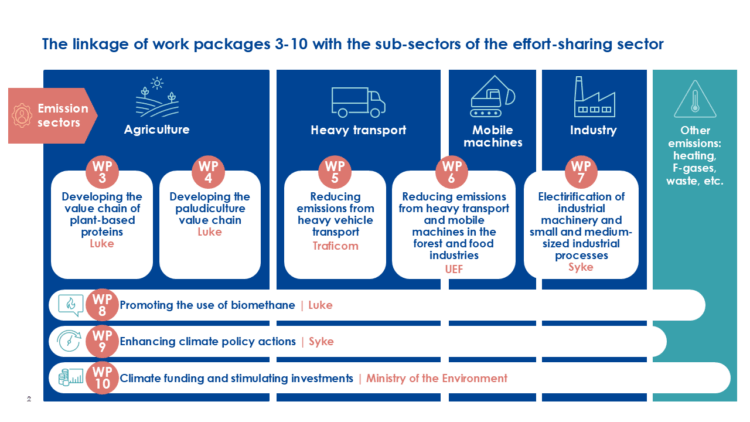
ACE includes several work packages that focus on concrete climate solutions across different sectors. These packages cover, among others, project coordination and communication, the development of a plant-based food system and value chains of paludiculture, emission reductions in heavy transport and industrial machinery, strengthening climate policy, and accelerating climate finance and investments. Below are the objectives and key actions of each work package.
Project coordination, communication, and training
Work packages 1 and 2 cover project coordination, communication, and training. The goal of communication and training is to ensure that ACE has a broad societal impact by:
- Sharing project results to support the scaling and replication of its outcomes
- Increasing public acceptance of climate actions and striving to mainstream climate finance, actions, and policies.
Contact information: Karoliina Auvinen, Syke and Kata Kreft-Burman, Syke (project coordination); Sini Harvo, Syke (communication) | firstname.lastname@syke.fi
Developing the plant protein value chain
The goal of the work package is to develop the activities of the actors of the plant protein value chain (food industry, retail stores, food services, restaurants, and civic organisations), which will ultimately lead to lower emissions.
Measures for reaching the goal
- Collaborative platform (Plant Protein Coalition (PPC)) for the development of the value chain (Luke)
- To upgrade the foods offered by companies we study the quality of protein sources (chemical and nutritional) (Luke)
- Increasing the procurement and consumption of plant proteins in carbon neutral municipalities (Syke)
- Increasing awareness, motivation among consumers, changing cultural food habits (WWF)
- Policy changes and spreading them (WWF)
Contact information: Markus Nurmi, Natural Resources Institute Finland | markus.nurmi@luke.fi
Developing the paludiculture value chain
The goal of the work package is to promote the attainment of Finland’s emission reduction goals in agriculture by reducing emissions from peat fields, and the use of peat in growing mediums.
Key actions:
Helping landowners in transitioning to paludiculture (Wetland Cultivation)(Luke, KMM, MTK Häme+SW Finland, Rural Women’s Advisory Organization).
Monitoring water-saturated locations and assessing the prerequisites for the development of the value chain.
The harvested biomass is used to produce different types of growing mediums, whose functionality is measured in experiments for growing lettuce, dill, and basil (KMM, Luke).
A greenhouse-scale supply of growing medium will be delivered to a commercial greenhouse in 2027 and user experiences will be collected (KMM, Famifarm).
Contact information: Kristiina Lång, Natural Resources Institute Finland | kristiina.lang@luke.fi
Reducing emissions from heavy transport
In the work package:
- trucks powered by electricity and natural gas, as well as charging infrastructure will be piloted.
- service concepts, the smart integration of the ecosystem of low-emission transport into the electric grid, and the local production of energy and storage systems will be developed.
Cooperative projects to be implemented in the work package:
- An experiment to be carried out in Naantali will show in practice how infrastructure and procedures for charging batteries can be implemented with low-emission lorries.
- A trial with electric-powered lorries in Arctic conditions in Kemi.
The aim is to produce researched information and knowledge on promoting the introduction of alternate power sources in heavy vehicle transport and to help, for example, buyers of equipment, transport service providers, shippers, and energy companies to consider which low-carbon solutions best meet their needs.
Contact information: Aki Tilli, Traficom | aki.tilli@traficom.fi
Reducing emissions from heavy transport and mobile machines in the forest and food industries
The goal of the work package is to help Finland reach its emission reduction goals in the effort-sharing sector especially for heavy machinery and transport in the forest and food industries.
To reach the goal in the work package, transport services using lorries powered by electricity and biogas will be piloted, low-emission machinery will be demonstrated, real-time reporting of the carbon footprint in wood procurement will be built, machine operators and vehicle drivers will be trained, systems that help drivers and machine operators to work more energy-efficiently will be tested, and methods of more efficient transport logistics will be studied.
In the work package, results of the research and the best practices that are found will also be communicated, and there will also be close cooperation with other work packages.
Contact information: Kalle Kärjä, UEF | kalle.karha@uef.fi
Electrification of industrial machinery and small and medium-sized industrial processes
ACE is seeking to reduce emissions from industrial machinery and small and medium-sized industries by promoting smart electrification investments to replace devices powered by fossil fuels.
The ACE project aims to implement the model investments of electrification in the Linkosuo bakery in Pirkanmaa and in the metal recycling process of Kajaanin Romu in Kainuu. Actions are to be scaled with the help of an investment tool kit, and by funding training and communications, as well as making policy recommendations.
Contact information: Karoliina Auvinen, Syke | firstname.lastname@syke.fi
Promoting the use of biomethane
The objective of this work package is to support emission reduction targets by promoting and enabling the use of biogas and other low-emission gaseous fuels in road transport, machinery, and small and medium-sized industries—sectors where electrification is challenging.
The project will assess the potential of gaseous fuels and evaluate their optimal use in different applications from an emission reduction perspective. Regarding biogas, the potential will be assessed particularly through new raw materials (e.g., wetland cultivation, plant-based protein production, and forest industry residues) in collaboration with other work packages. Additionally, guidelines and policy recommendations will be developed, including necessary regulatory changes, especially to improve the investment environment for small and medium-sized enterprises.
Contact information: Saija Rasi, Luke | saija.rasi@luke.fi
Greater efficiency in climate policy measures
The goal of the work package is to develop climate action by visualising paths toward a more ambitious climate policy by identifying and clearing away obstacles.
In expert workshops organized by the ACE project, climate policy pathways are co-developed and sector-specific policy recommendations are prepared.
Contact information: Aino Rekola, Syke firstname.lastname@syke.fi
Climate funding and expediting investments
The goal of the work package is to promote effective targeting of climate funding, to support applications for external funding, and to promote the scaling of climate innovations.
In the ACE project, a report will be prepared on proposals to enhance the effectiveness of climate funding, along with a tool for assessing the climate impact of projects to be funded. An expert network on climate finance will support this work. During the project, up-to-date information on climate funding will be provided and climate-themed project concepts will be developed.
Contact information: Miia Berger, Ministry of the Environment | miia.berger@gov.fi