Era of a sustainable energy system (2046–2055)
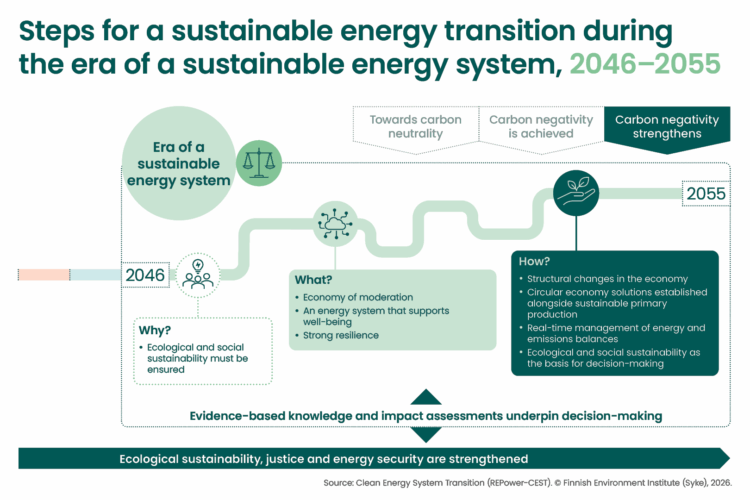
During the era of a sustainable energy system (2046–2055), ecological and social sustainability guide decision-making across society. A society based on ecological and fair sufficiency continues to develop towards greater carbon negativity. The energy system is based on real-time balancing of energy flows, supports wellbeing and is highly resilient. Fusion energy is introduced.
Why is change needed?
- Climate change has altered ecosystems. Protected areas have expanded, and ecological restoration has progressed. Long-term climate commitments and their implementation are steering the economy towards carbon-negative EU markets.
- The global use of natural resources remains high but is increasingly shifting toward recyclable materials.
- Reducing consumption and improving production efficiency remain essential for operating within planetary boundaries.
- Climate-induced migration and unequal access to resources increase the need for cooperation and highlight the importance of shared responsibility and eco-social well-being.
- Advancing social justice continues to require action at global, regional, and intergenerational levels.
- International cooperation is a prerequisite for aligning climate, energy, and natural resource policies.
What is the aim of the change?
- A carbon-negative, real-time managed, and fully integrated energy system.
- A more moderate economy and consumption patterns, with the circular economy firmly established and markets supporting sustainable practices.
- Evidence-based and participatory decision-making, ensuring public acceptance and social justice.
- Finland being an international role model and active contributor, supported by international institutions that guide sustainable development.
How is the change implemented?
- Establishing system-level governance and continuous development to ensure close integration between sectors and optimisation of the energy system as a whole.
- Making ecological boundaries the foundation of decision-making, with planetary limits and biodiversity impacts guiding policy and governance.
- Adapting economic structures toward a sufficiency-oriented economy through policy instruments, pricing mechanisms, and regulation.
- Strengthening fairness, inclusiveness, and public acceptance throughout the transition process.
Fictive future news: Finland is recognised as an energy-efficient and thriving society
Global Futures Review Copenhagen, 3 July 2055
Finland is widely regarded as an example of how an energy system can be transformed sustainably while simultaneously strengthening societal wellbeing.
In the Finnish model, the energy system is not a separate sector but an integral part of everyday life, local communities and public services. Revenues generated from renewable energy production are transparently channelled into municipal services, such as social and healthcare services, which has strengthened the acceptability of the system.
Energy communities have become an established part of local infrastructure. Residents jointly own production and storage solutions, and decision-making at the everyday level is participatory. In many locations, community “energy cafés” have become part of the local culture.
At the same time, the use of materials has undergone a fundamental transformation. Mining and industry operate as part of a circular economy in which side streams are systematically utilised and only minimal permanent waste is generated. Resource efficiency and ecological sustainability guide all production.
Energy infrastructure has become integrated into the landscape and local identity. The balanced distribution of benefits and impacts has reduced conflicts and strengthened trust.
The widely recognised campaign “Energy from joy!” encapsulates the underlying mindset: energy efficiency does not mean scarcity, but rather a way of life in which wellbeing and sustainability reinforce one an-other.
Finland is spoken of as a country where energy efficiency and happiness go hand in hand.
Fictive future news
The roadmap includes fictive future news that illustrate the key messages by describing possible future scenarios at different stages of the transition. These scenarios help make the roadmap’s implications more concrete and provide examples of how a sustainable energy future could unfold over time.
Sampo Soimakallio
Development Manager, Finnish Environment Institute
sampo.soimakallio@syke.fi
Funded by the European Union – NextGenerationEU. Views and opinions expressed are however those of the author(s) only and do not necessarily reflect those of the European Union or European Commission. Neither the European Union nor the European Commission can be held responsible for them.