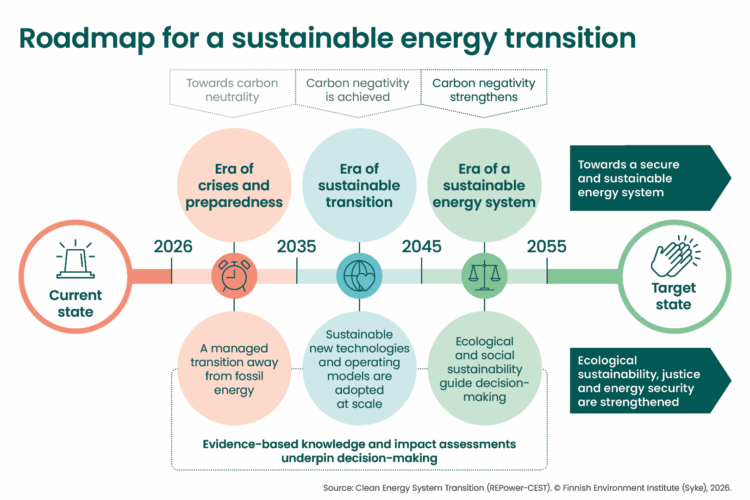
Roadmap for a sustainable energy transition
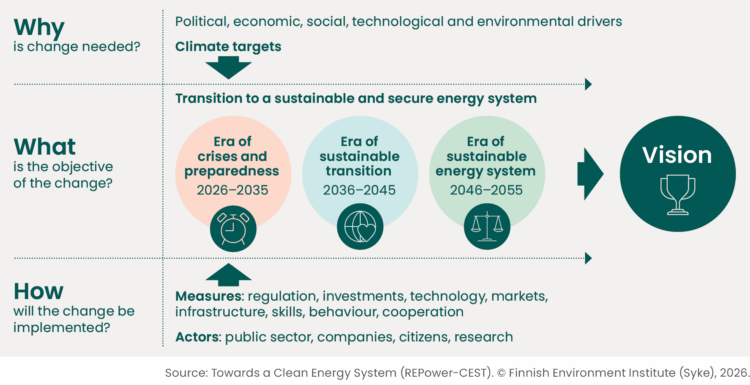
Transition to a sustainable energy system
Kestävä energiasiirtymä on lähivuosien ja vuosikymmenten aikana välttämätön A sustainable energy transition will be essential to achieve our climate goals over the coming years and decades. Implementing this transition will require significant action across all sectors of the economy and at every level of society.
The roadmap for a sustainable energy transition brings together a vision and the key elements shaping the transition towards it up to 2055. The vision describes the state towards which society and the energy system are intended to develop. The roadmap is structured into three consecutive time periods, which describe the evolution of the energy transition over different time horizons:
- the era of crises and preparedness (2026–2035)
- the era of sustainable transition (2036–2045)
- the era of a sustainable energy system (2046–2055)
Within these periods, the transition is analysed using a consistent framework based on the questions why, what and how. Additionally, the roadmap includes fictive future news that make its key messages more tangible by describing possible future scenarios at different points along the roadmap’s timeline.
Vision 2055: Finland as a model country for a sustainable energy system enhancing comprehensive security
- Finland has phased out fossil fuels successfully and in a managed manner.
- National medium-term (2035) and long-term (2050) climate targets have been achieved without significantly compromising biodiversity, the condition of water bodies, or other aspects of the environment.
- The energy system is efficient, flexible, and based on multiple technologies, enhancing resilience to crises and strengthening overall security.
- Finland has transitioned to a circular economy and resource-efficient use of raw materials, including in the mining sector.
- The sustainability assessment of the energy transition is grounded in broad expertise and reliable data, while the active participation of stakeholders fosters trust.
- The acceptability of the energy transition has been ensured through evidence-based decision-making and policy instruments perceived as fair.
- A sustainable economy is founded on social justice, moderate consumption, and safeguarding the functioning of natural ecosystems.
Key elements of a sustainable energy transition
Technologies and solutions
- Wind power
- Solar power
- Heat pumps and geothermal energy
- Bioenergy and biofuels
- Electrofuels (e-fuels)
- Small-scale nuclear technologies
- Energy efficiency and energy-saving technologies
- Carbon capture and storage
- Energy storage technologies
- Fossil-free technologies for transport, buildings, services, and industry
- Smart solutions and sector integration to enhance system flexibility
Nature and climate objectives
- Reducing greenhouse gas emissions through the transition to clean energy
- Restoring the land-use sector as a significant carbon sink
- Expanding protected areas
- Reducing the intensity of forest use
Prerequisites for a sustainable transition
- Considering environmental, economic, and social impacts
- Minimising negative impacts and ensuring a fair distribution of benefits and costs
- Incorporating sustainable growth, comprehensive security, equity, and cost-effectiveness into policies and investments
- Evidence-based governance and impact assessment in decision-making
Enablers of implementation
- Commitment and participation across society
- International cooperation
- Recognition of different transition pathways (technologies, consumption patterns, economic structures, policy instruments, and energy security)
Purpose of the roadmap
The roadmap brings together research-based key actions through which the transition progresses at different stages. The focus is on the overall set of measures and their combined impacts, through which the energy system can move in a managed way toward a sustainable target state. The roadmap is intended to serve as a foundation for further work, in which its findings can be refined and translated into more concrete, actor-specific, and strategic roadmaps for different aspects of the energy transition.
This website presents a concise overview of the roadmap’s central content. More detailed descriptions and additional information can be found in the publication Transition to a sustainable energy system: Roadmap and synthesis report (helda.helsinki.fi).
The Roadmap for a Sustainable Energy Transition was developed as part of the Clean energy system transition (REPower-CEST) project. The roadmap process involved a broad group of researchers and experts from the Finnish Environment Institute (Syke), the Geological Survey of Finland (GTK), and VTT Technical Research Centre of Finland Ltd. The project also included extensive stakeholder engagement, and the roadmap work was carried out in collaboration with the REPower project of the Natural Resources Institute Finland (Luke)(you are switching to another service).
Sampo Soimakallio
Development Manager, Finnish Environment Institute
sampo.soimakallio@syke.fi
Funded by the European Union – NextGenerationEU. Views and opinions expressed are however those of the author(s) only and do not necessarily reflect those of the European Union or European Commission. Neither the European Union nor the European Commission can be held responsible for them.