Era of crises and preparedness (2026–2035)
During the era of crises and preparedness (2026–2035), the focus is on phasing out fossil fuels across all energy-consuming sectors, rapidly increasing clean energy production, and strengthening electricity, hydrogen and other gas infrastructures as well as energy security. At the same time, the knowledge base required to implement the sustainable transition must be improved and applied in legislation to minimise harmful environmental impacts and enhance the fairness and social acceptability of the transition.
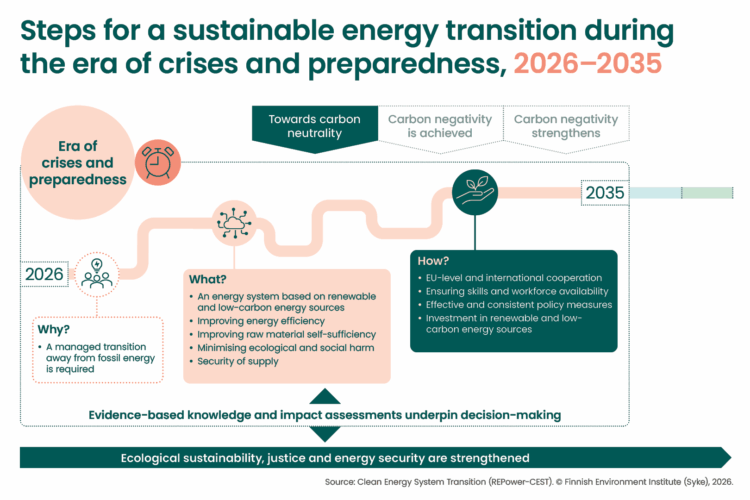
Why is change needed?
- Reducing the use of imported fossil fuels enhances energy security, lowers emissions, and accelerates sustainable green growth in Finland.
- Energy production will become almost entirely free of fossil emissions in the near future, but efforts to reduce fossil emissions from industry and transport must be accelerated.
- Current policies do not sufficiently steer development in a way that would enable climate, biodiversity, and other environmental objectives to be achieved in a socially acceptable manner.
- Demand for critical mineral raw materials is increasing, and ensuring their availability for clean energy technologies poses challenges throughout the value chain.
What is the aim of the change?
- An energy system based on renewable and low-carbon energy sources, covering energy production, transmission, and all end-use sectors.
- Improved energy efficiency across all energy sectors and throughout the energy system as an integrated whole.
- Greater raw material self-sufficiency through increased material efficiency, recycling, and the sustainable production of mineral resources.
- Minimising and compensating ecological and social impacts.
- Enhanced security of supply through greater self-sufficiency and proactive risk management.
How is the change implemented?
- Strengthening cooperation at the EU level and through other international partnerships.
- Ensuring a strong knowledge base through education and securing the availability of a skilled workforce.
- Advancing the energy transition efficiently and consistently at the national level, aligned with EU policies and objectives.
- Providing sufficient investment and support for renewable and low-carbon energy sources across the entire energy system.
Fictive future news: Government outlines: the benefits of the energy transition to be distributed in a new way
Government Communications Helsinki, 2 September 2030
The Government has decided to introduce a new model for distributing the economic benefits and costs of the energy transition more evenly between households and regions than before.
The decision, taken during the budget negotiations, is based on a so-called balance of externalities, which brings together the economic impacts of energy investments, the value added generated, and the costs associated with environmental impacts. This approach makes transparent how the revenues and costs of the energy system are distributed among different actors and regions.
The key reform is a dividend mechanism for the energy transition. Through this mechanism, a share of the revenues generated by the energy system will be automatically channelled to households. In practice, this means compensation targeted especially at low-income households to offset housing and heating costs.
Another significant decision concerns the regional distribution of benefits. Municipalities that produce renewable energy will in future receive a more stable revenue stream. In return, municipalities commit to mitigating the environmental impacts of energy production and implementing ecological compensation.
”The biggest change is that the distributional impacts of the energy system are no longer left to chance, but are consciously steered”, an expert involved in the preparation estimates.
Fictive future news
The roadmap includes fictive future news that illustrate the key messages by describing possible future scenarios at different stages of the transition. These scenarios help make the roadmap’s implications more concrete and provide examples of how a sustainable energy future could unfold over time.
Sampo Soimakallio
Development Manager, Finnish Environment Institute
sampo.soimakallio@syke.fi
Funded by the European Union – NextGenerationEU. Views and opinions expressed are however those of the author(s) only and do not necessarily reflect those of the European Union or European Commission. Neither the European Union nor the European Commission can be held responsible for them.