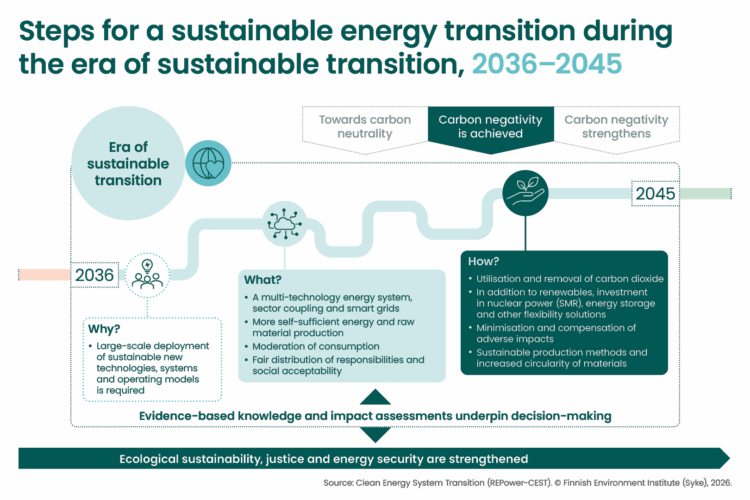
Era of sustainable transition (2036–2045)
During the era of sustainable transition (2036–2045), the energy system becomes increasingly multi-technology, decentralised and integrated; the circular economy strengthens the sustainable foundation of the economy alongside primary production; and ecological sustainability, fairness and social acceptability become even more prominent. During this phase, new technologies are deployed, including carbon capture, utilisation and storage, as well as operating models to achieve carbon negativity in an ecologically sustainable and socially acceptable manner.
Why is change needed?
- The focus of this period is the large-scale deployment of sustainable new technologies and operating models.
- Progress toward a carbon-negative society must be achieved in an ecologically sustainable and socially acceptable manner.
- Offsetting the remaining fossil emissions and making society carbon-negative will require the expansion of technological carbon removal solutions.
- Additional sustainable electricity generation will be needed as end-use sectors become increasingly electrified and to support investments in the hydrogen economy.
- Locating investments in ways that are ecologically sustainable, socially acceptable, and economically viable from a grid infrastructure perspective presents significant challenges.
- Expectations regarding the fairness of the transition are increasing, and public trust, participation, and perceptions of justice are essential for the success of sustainable energy transition.
What is the aim of the change?
- Greater self-sufficiency in energy and raw material supply to enhance comprehensive security and reduce dependence on actors outside the EU.
- Improved management of information related to critical raw materials is needed for the energy transition at both Finnish and EU levels.
- More sustainable consumption patterns to enable the achievement of long-term sustainability objectives.
- A more technologically diverse and intelligent energy system in which different technologies increasingly complement one another.
- Strengthened electricity grids to support electrification in transport, industry, and heating.
- Changes in energy sources:
- Phasing out or significant reduction of fossil fuel consumption.
- Reduced use of wood for energy production.
- Expansion of nuclear power generation.
- Increased deployment of carbon capture, utilization, and storage (CCUS).
- Strengthening the production, processing, and recycling of critical materials required for the energy transition, as well as material-efficiency solutions, in response to growing demand.
How is the change implemented?
- Embedding the principles of sustainable growth, fairness, and cost-effectiveness as guiding factors in energy investment decisions.
- Adapting societal structures to support the moderation of energy and resource consumption.
- Applying stricter environmental criteria when guiding the location of energy-transition investments.
- Allocating a share of mining tax revenues to a fund that compensates future generations for today’s use of raw materials.
- Improving technological compatibility and extending product lifecycles through innovation and regulation.
- Accelerating the deployment of emerging technologies, including small-scale nuclear power, energy storage, demand response, and carbon removal solutions.
- Conducting more comprehensive assessments of the overall economic impacts of new industrial investments.
Fictive future news: Electricity bills have fallen – Smart home energy has transformed daily life
Everyday Life & Energy Tampere, 12 May 2038
Many households are now saving hundreds of euros per year without having to significantly change their daily routines.
Electricity bills in Finland have declined markedly in recent years as homes have evolved into intelligent energy service hubs. Automated systems manage heating, electricity use and storage in real time based on weather data, market prices and the routines of residents.
“I no longer think about when it makes sense to use electricity – the system takes care of that for me. And the bill is still lower,” says a resident of Tampere.
Local energy applications complement automation by displaying the load status of the local grid and offering simple suggestions for scheduling consumption.
“Move your laundry to the evening – save money and balance the load,” the application indicates during peak periods.
An energy diary used in homes makes savings visible. It shows how automation and residents’ choices together have smoothed consumption peaks, reduced carbon footprints and lowered costs.
–The biggest change is that consumption is optimised without the user having to do much at all – and costs still decline, an expert notes.
Fictive future news
The roadmap includes fictive future news that illustrate the key messages by describing possible future scenarios at different stages of the transition. These scenarios help make the roadmap’s implications more concrete and provide examples of how a sustainable energy future could unfold over time.
Sampo Soimakallio
Development Manager, Finnish Environment Institute
sampo.soimakallio@syke.fi
Funded by the European Union – NextGenerationEU. Views and opinions expressed are however those of the author(s) only and do not necessarily reflect those of the European Union or European Commission. Neither the European Union nor the European Commission can be held responsible for them.